
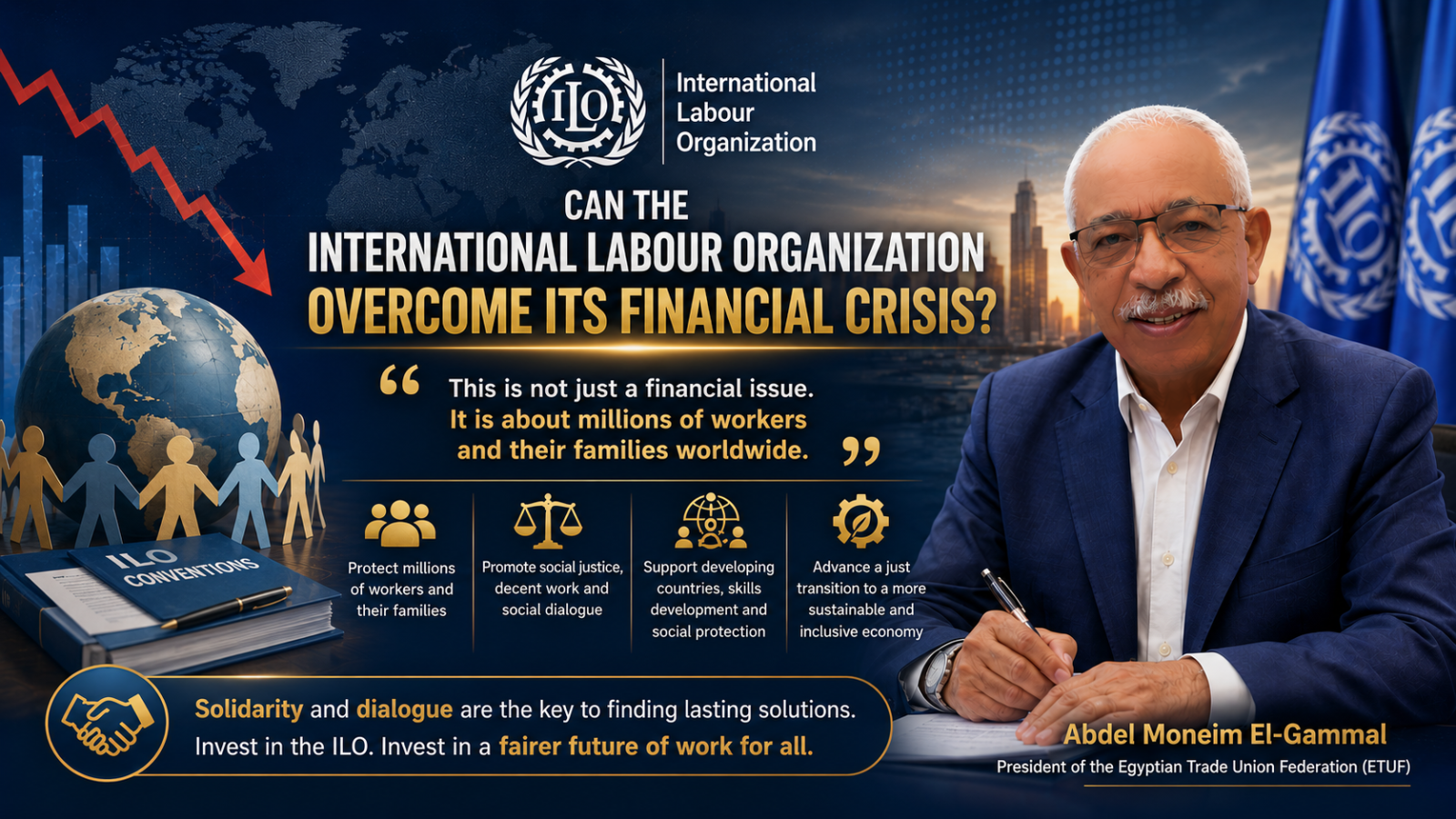
By: Abdel Monem El-Gamal
President of the Federation of Egyptian Trade Unions (ETUF)
In the midst of the successive economic crises the world is witnessing, the financial crisis facing the International Labour Organization (ILO) might seem to some as merely an administrative or financial issue concerning a UN agency. However, the truth goes far beyond that. This crisis directly affects the future of millions of workers and their families across the globe.
The ILO is not a traditional bureaucratic institution; rather, it is one of the most prominent international bodies that has contributed, for over a century, to deep-rooting the principles of social justice, decent work, and social dialogue. Through this organization, international labor standards were developed to become a reference point for governments, employers, and workers in building more balanced and stable labor relations.
Today, the Organization faces a real challenge due to accumulating financial pressures resulting from the delay of some member states in paying their mandatory contributions, alongside the ongoing impacts of global inflation and the rising costs of implementing programs and projects. While this may appear on the surface to be a purely financial matter, in essence, it reflects on the Organization’s capacity to support developing nations, upskill workers, strengthen social protection systems, and back efforts toward a just transition into a more sustainable economy.
From our standpoint of trade union responsibility, we view this crisis as a true test of the international community’s commitment to the values of social justice that everyone speaks of. When the resources allocated to support decent work decline, workers are the first to pay the price—especially in countries that still face massive challenges in employment, social protection, and skills development.
Addressing this crisis must not be limited to austerity measures or cutting down programs. Instead, it requires a broader vision based on enhancing international solidarity and ensuring that member states fully shoulder their responsibilities. Furthermore, the time has come to explore innovative and sustainable mechanisms to fund the Organization’s programs in a way that preserves its independence and guarantees the continuity of its mission.
In my assessment, dialogue among governments, employers, and workers remains the most vital tool to overcome this phase. The world is changing at an unprecedented pace under the influence of technological, digital, and environmental transformations. This reinforces the need for a strong international institution capable of keeping pace with these variables and protecting human rights in the world of work.
History has proven that major crises can also be opportunities for rebuilding and development. Hence, the current financial crisis should push us to reflect on the future of the International Labour Organization and its role during the coming decades, rather than being a reason to weaken it or diminish its impact.
Defending the strength of the ILO is not merely defending an international institution; it is a defense of every worker’s right to a decent job opportunity, a fair wage, social protection, and a safe working environment. In a world of growing challenges and widening social gaps, this mission remains more critical than ever.